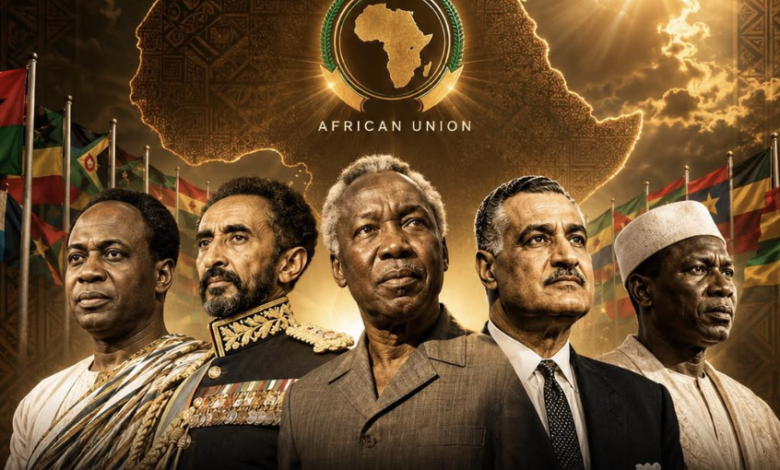
Imagine a continent that has just freed itself from colonization. Dozens of new countries, millions of people reclaiming their freedom. And leaders asking themselves one big question: what if we did all of this together?
That is exactly what happened in Addis Ababa, Ethiopia, on May 25, 1963. On that day, 32 African heads of state signed the Charter of the Organisation of African Unity. Among them were men that history has never forgotten.
The most passionate champion of unity was Kwame Nkrumah. Born in 1909 in Ghana, he led his country to independence in 1957 — a first in sub-Saharan Africa. But for him, that was not enough. He wanted to unite the entire continent, like the United States of America. « The independence of Ghana is meaningless unless it is linked up with the total liberation of Africa, » he said. A huge dream, carried by a remarkable man.
It was at the home of Haile Selassie I, the Emperor of Ethiopia, that this great meeting took place. He opened his doors and presided over the birth of the OAU. Ethiopia had never been colonized — it was hard to find a better symbol to host the birth of a free Africa.
Further to the west, Ahmed Sékou Touré, President of Guinea, was already a legend. Five years earlier, in 1958, he had said no to France in a single breath, with a phrase everyone still remembers: he preferred « freedom in poverty to richness in slavery. » In Addis Ababa, his voice carried far.
Julius Nyerere led Tanzania with gentleness and intelligence. His people called him Mwalimu, which means « the teacher » in Swahili. He believed that African peoples were like one big family — they had to support each other and move forward together.
And then there was Léopold Sédar Senghor. As much a poet as a president of Senegal, he brought a more careful vision: building African unity slowly, respecting each country’s own path. Not always in agreement with Nkrumah, but driven by the same love for Africa.
These men were not all alike. They did not always think the same way. But on that May day in 1963, they chose to set aside their differences and build something great together. The OAU became the African Union in 2002 — and their dream lives on.